
From Access to Agency: Through a Parent’s Lens
From Access to Agency
Through a Parent’s Lens
Why “I Don’t Know” Doesn’t Always Mean Your Child Doesn’t Know
How Helping Children Access What They Know Can Build Deeper Thinking, Confidence, and Independence
Dana Zottoli, M.S.Ed., 6th Year
Founder, Inside Learning, LLC
About this perspective
This article is written through a parent’s lens and reflects insights shaped by both lived experience as a parent and 26 years of educational practice, professional learning, observation, implementation, and reflection. It is part of Inside Learning’s ongoing work exploring how access, awareness, and intentional support can help learners develop greater independence and agency.
You know your child knows this.
They explained it yesterday. They talked about it in the car. Maybe they even got a similar question right at school.
But now the homework is in front of them.
You ask a question.
They stare at the page.
“I don’t know.”
For parents, moments like this can be confusing and frustrating. Is my child not paying attention? Did they forget? Are they avoiding the work? Do they really not understand?
Sometimes the answer is simpler—and more hopeful.
Your child may know more than they can access at that moment.
At Inside Learning, this is why I often encourage parents to stay curious long enough to understand before they decide. When we pause before interpreting a child’s response as avoidance, lack of effort, or inability, we create space to ask a different question: What might be happening in the learning beneath the behavior?
Understanding the difference between what a child knows and what a child can access and use can change the way we respond when learning becomes difficult.
What Does “Access” Mean?
Here, access means something very practical:
Can my child get to what they know when they need it?
Imagine your child has learned what a desert is and what a rainforest is. They may be able to tell you facts about both.
Then someone asks:
“How is a desert habitat different from a rainforest habitat?”
Suddenly, your child has to do much more than remember a fact.
They have to retrieve what they know about both habitats, hold those ideas in mind, figure out which information matters, compare it, organize their thinking, and find the words to explain it.
And perhaps they have to do all of that while worrying:
“What if I get it wrong?”
So “I don’t know” may not mean:
“I know nothing about this.”
It may mean:
“I don’t know where to start.”
“I can’t hold all of this in my head at once.”
“I know something, but I can’t explain it.”
“There are too many things to think about.”
That distinction matters.
Difficulty accessing thinking is not the same thing as an inability to think deeply.
Children Need Something to Think With
Before children can compare, explain, infer, solve problems, or make connections, they need something solid to think with.
They need organized knowledge.
Consider a child learning about bees.
At first, they may learn separate facts: bees have six legs, live in hives, collect nectar, and pollinate flowers.
With repeated learning and experience, those facts begin connecting into a larger mental picture of a bee.
Now the child can begin thinking with that knowledge:
How is a bee different from a butterfly?
What happens after a bee collects nectar?
Why are bees important to flowers?
What might happen if bees disappeared?
Those questions require increasingly complex thinking. But that thinking becomes possible because the child has something organized and accessible to think with.
Children often need knowledge before they can reason with knowledge.
From Knowing to Thinking
In school, children encounter several common ways of organizing information. But these aren't just reading skills. They can also be understood as ways of thinking:
Description: What is it?
Sequence: What happened first, next, and last?
Compare and Contrast: How are these things alike and different?
Cause and Effect: Why did this happen?
Problem and Solution: What needs to change, and what could we do?
Notice how the thinking becomes more demanding.
Before children can compare two animals, they need to know something about each animal. Before they can explain why something happened, they need to understand the situation. Before they can solve a problem, they need to recognize what is happening and what might need to change.
That is why “What do you know?” can be such a powerful place to begin.
Your Child’s Brain Has a Limited Workspace
Your child can only hold and work with so much information at one time.
This temporary mental workspace is often called working memory. Think of it like a small worktable.
If that table is already covered with remembering directions, retrieving facts, figuring out vocabulary, organizing an answer, ignoring distractions, and worrying about being wrong, there may not be much room left for reasoning.
So when a child becomes stuck, adding more information or repeating the question may not always help.
Sometimes we need to clear some space.
That might mean:
showing information visually;
breaking a task into smaller parts;
reminding the child of something they already know;
giving additional processing time;
allowing them to draw instead of immediately explaining;
using a sentence starter; or
pausing until their body and emotions are more regulated.
These supports don't do the thinking for the child.
They can make more of the child's own thinking available.
Every Child Can Become Overloaded
All children experience moments when the demands of a task exceed what they can comfortably manage.
Some children may experience those moments more frequently or intensely.
Children with neurodivergence, including some children with ADHD, autism, dyslexia, language or learning differences, may process, organize, retrieve, or express information differently. Anxiety, chronic stress, and trauma can also consume some of the mental resources a child would otherwise use for learning.
This does not mean these children are incapable of complex thinking.
Many demonstrate sophisticated reasoning, creativity, pattern recognition, deep knowledge, and unique ways of seeing problems.
The question becomes less:
“Why can't my child do this?”
and more:
“What is making it difficult for my child to access what they know right now?”
That shift invites curiosity instead of judgment.
This is what it can mean to look for the learning beneath the behavior: not excusing the struggle or assuming its cause, but becoming curious enough to understand what may be getting in the way before deciding what support is needed.
Support Is Not the Opposite of Independence
Parents sometimes wonder:
Am I helping too much?
Shouldn't my child be able to do this independently?
Will support make my child dependent on me?
Appropriate support can actually help independence develop.
Think about learning to ride a bicycle. Training wheels temporarily reduce one demand while a child practices pedaling, steering, stopping, and gaining confidence.
The goal isn't to keep the training wheels forever. It's to provide enough support for the child to practice successfully until they can manage more independently.
Learning supports can work the same way.
A visual organizer, predictable routine, example, sentence starter, movement break, or additional processing time can temporarily carry part of the load while a child develops the ability to organize that thinking independently.
Good support doesn't replace independence. It can help build it.
Make Thinking More Accessible
Predictability can help children spend less energy figuring out what is happening and more energy thinking about what they are learning.
At home, this can be simple:
“First we'll read the page. Then we'll talk about what you noticed.”
“Let's find three things you already know before we answer the question.”
“You can tell me, draw it, or show me.”
Children are also frequently asked to perform thinking that adults have learned to do silently.
Instead of only asking for the finished answer, make the process visible.
You might say:
“We know two things. I wonder if they're connected.”
Or:
“Penguins have thick feathers, and they live where it's very cold. I wonder whether those two facts have something to do with each other.”
Now reasoning isn't magic.
It's connecting information.
Let Reasoning Feel Like Discovery
Children who have experienced repeated difficulty may begin expecting themselves to be wrong.
A question can start to feel like a test rather than an invitation to think.
Instead of asking:
“Why do penguins have thick feathers?”
try:
“We know penguins have thick feathers, and we know they live where it's very cold. What do you notice when you put those two things together?”
Your child might say:
“Maybe their feathers help them stay warm.”
That's reasoning.
They used two things they already knew to create a new idea.
The inference emerged through discovery.
Give Your Child Language—and Different Ways—to Think
Sometimes children recognize a connection before they have the language to explain it.
Simple sentence starters can help:
I noticed…
This reminds me of…
These might be connected because…
First I thought…
Now I think…
I changed my thinking because…
Children may also express their thinking differently.
One child may talk. Another may draw or build. Another may need to move while talking. Another may need quiet and additional time before responding.
When the goal is reasoning, we can sometimes be flexible about how that reasoning is expressed.
Offering multiple ways to show understanding does not necessarily lower the intellectual expectation.
Sometimes it removes a barrier that was preventing us from seeing what the child actually knows.
When “I Don’t Know” Is the Starting Point
So what can you actually do when your child says:
“I don't know”?
You don't need to become the teacher, give the answer, or work through a complicated strategy.
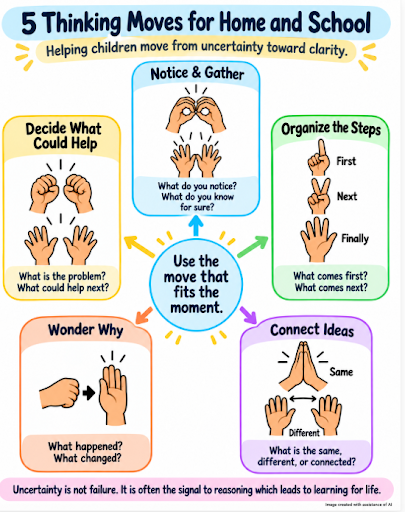
Sometimes one Thinking Move can provide a way back into the thinking.
Notice & Gather when your child doesn't know where to begin.
Organize the Steps when the information feels jumbled.
Connect Ideas when they know pieces of information but aren't seeing the relationship.
Wonder Why when they're ready to explore what happened or changed.
Decide What Could Help when they're ready to identify a problem and consider what might help next.
You don't need to use all five.
Use the move that fits the moment.
The goal isn't for you to choose the move forever. Over time, your child can begin recognizing:
“I'm stuck. What kind of thinking might help me right now?”
Instead of uncertainty automatically becoming:
“I can't.”
it can become:
“I need another way into this.”
Support can become strategy. Strategy can become agency.
From Learning Skills to Life Skills
There is a bigger reason these thinking patterns matter.
Eventually, children can use them not only to understand schoolwork but also to understand themselves and their experiences.
A child might begin with:
“I like drawing.”
Then:
“I started drawing when I was little.”
Later:
“Drawing helps me feel calmer when I'm worried.”
Eventually:
“When I'm overwhelmed, drawing for a few minutes is something I can choose before I try again.”
Something important has changed.
The child has moved from knowing something about themselves to knowing something they can do to help themselves.
That is the beginning of agency.
The same shift can happen in learning.
Instead of:
“I'm bad at reading.”
“I'm not smart.”
“I can't do this.”
a child can gradually build a different story:
I understood something.
I figured something out.
I tried another way.
I asked for help.
I know something that helps me learn.
Confidence doesn't have to come from repeatedly telling children they are capable.
Confidence can grow when children experience their own capability.
And eventually, instead of waiting for an adult to tell them what to do next, children can begin asking themselves:
What do I notice?
Do I need to put this in order?
What might be connected?
What changed?
What could help next?
That is movement from support toward self-awareness—and from self-awareness toward agency.
When Your Child Is Overwhelmed
There will also be moments when thinking isn't the first priority.
If your child is overwhelmed, frustrated, anxious, or dysregulated, asking more questions may simply add another demand.
Reduce the load first.
Pause.
Move.
Take a drink of water.
Draw.
Use a visual.
Take a sensory break.
Break the task into one manageable step.
You might simply say:
“This feels like a lot of information at once.”
Then, when your child is ready, return to something accessible:
“What do we already know?”
Emotional regulation isn't separate from learning.
Sometimes feeling regulated enough to think is what makes learning accessible again.
And sometimes the most appropriate Thinking Move is no Thinking Move at all.
Regulation can come first.
The Bigger Picture
The goal isn't simply to help children answer more questions correctly.
We want children to gradually understand:
How do I think?
How do I learn?
What helps me?
What can I do when something feels difficult?
Knowledge gives children something to think with.
Connection helps them organize what they know.
Reasoning helps them create new understanding.
Reflection helps them learn from experience.
Perspective-taking helps them understand other people.
And appropriate support helps make those processes accessible.
At first, an adult may ask:
“What do you notice?”
Eventually, the child may begin asking:
“What do I notice?”
At first, an adult may ask:
“What could help next?”
Eventually, the child may begin asking:
“What could help me next?”
That change matters.
The support that once existed around the child is gradually becoming a strategy within the child.
Accessibility doesn't have to mean lowering expectations.
It can mean creating the conditions children need to reach them.
Over time, the question can begin shifting from:
“Can I do this?”
to:
“What do I know? What do I notice? What do I need to move forward?”
That is more than academic learning.
That is the beginning of agency.
Try This Today
The next time your child says:
“I don't know.”
Before explaining the answer, correcting them, or asking the question again, try one thing:
“What do you notice?”
or:
“What do you know for sure?”
Then give them time.
Let them talk, draw, point, move, or show you.
If they're still stuck, ask yourself:
“What kind of support might help them access their thinking right now?”
You may discover that the first step isn't giving your child more information.
It's helping them find a pathway to what is already there.
Recognize what is happening. Reframe the struggle. Align the support. Engage the learner.
Because when children learn how to access what they know, recognize what kind of thinking may help, and choose what to do next, they are developing something larger than a strategy for homework.
They are learning how to become agents in their own learning.
