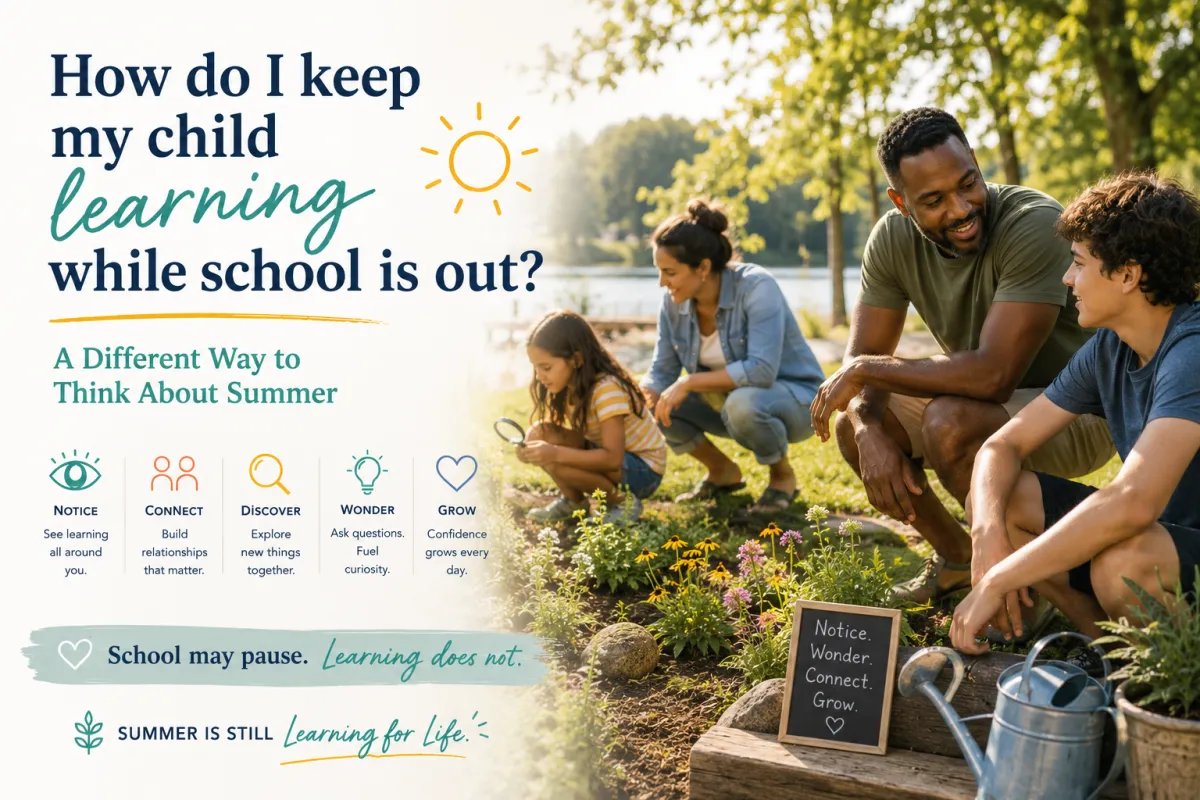
Learning for Life: A Different Way to Think About Summer
In this article:
Summer Brings a Familiar Question
School May Pause. Learning Does Not.
Awareness, Regulation, and Agency
Summer Brings a Familiar Question
Summer often brings a familiar question for parents:
How do I keep my child learning while school is out?
It's a question rooted in care, concern, and a desire to support growth. Yet sometimes the question itself causes us to overlook something important:
Learning never stops.
School may pause, but learning continues every day through experiences, relationships, challenges, conversations, curiosity, and reflection.
This summer, I invite you to consider a different question:
What learning is already happening here?
When we begin to notice learning through this lens, summer becomes more than a break from school. It becomes an opportunity to recognize the many ways children continue to grow and develop through everyday life.
Many parents feel pressure to keep academic skills sharp during the summer months. While reading, writing, and other academic routines can certainly be valuable, they are one part of learning.
Growth is happening all around us, often in ways that are difficult to measure but deeply important to development.
A conversation at the dinner table builds communication.
A disagreement between siblings develops perspective-taking.
A family outing creates opportunities for planning, flexibility, and problem-solving.
These experiences may not look like school, but they are powerful learning opportunities nonetheless.
School May Pause. Learning Does Not.
Learning is not confined to classrooms, worksheets, or report cards.
Learning happens when children solve problems, navigate friendships, ask questions, make mistakes, try again, and discover new possibilities.
Learning happens through:
• Experiences
• Relationships
• Challenges
• Conversations
• Curiosity
• Reflection
A child building a sandcastle is learning.
A teenager managing responsibilities is learning.
A college student navigating new independence is learning.
Learning is happening all around us, often in ways that are easy to overlook because they do not always resemble traditional academics.
The more we learn to notice learning, the more opportunities we have to nurture it.
Learning is embodied, emotional, social, and cognitive.
Children learn through movement, exploration, observation, conversation, and experience.
Summer provides countless opportunities for these forms of learning to occur naturally.
When parents begin looking beyond grades and assignments, they often discover growth in confidence, resilience, communication, self-awareness, and independence.
Learning for Life Across Ages
Learning looks different across developmental stages, but growth continues throughout life.
Young children learn through play, exploration, movement, language, and curiosity. They are developing awareness of themselves, others, and the world around them.
Elementary-aged children begin building friendships, routines, responsibility, communication skills, and problem-solving abilities. They are learning how to manage increasing expectations while growing confidence and independence.
Middle school students are exploring identity. They are discovering who they are, how they fit into the world, and how their choices affect others. Perspective-taking and self-awareness continue to develop.
High school students expand learning beyond academics. They develop leadership, decision-making, self-advocacy, future planning, and personal responsibility. They begin connecting present experiences to future goals.
College students navigate increasing independence, agency, purpose, and responsibility. They learn to solve real-world problems, manage competing demands, and define their own pathways forward.
Across every age and stage, learning remains a lifelong process of growth, adaptation, and discovery.
Awareness, Regulation, and Agency
Many of the skills that support learning and success begin long before we see measurable outcomes.
Growth often follows a progression:
Awareness helps us notice.
Children notice patterns, experiences, emotions, relationships, and opportunities.
Awareness helps us recognize what is happening within ourselves and around us.
Regulation helps us respond.
Once we notice, we learn to respond.
Regulation helps children manage emotions, recover from challenges, adapt to change, and navigate difficult situations.
Agency helps us act.
As awareness and regulation develop, children become increasingly capable of acting with confidence and intention.
Agency grows when children begin to believe:
"I can figure this out."
"I can learn from this."
"I can take the next step."
These capacities support learning, relationships, well-being, and growth throughout life.
This progression reflects an important truth:
Awareness fuels growth.
The more children learn to notice, regulate, and respond, the more capable they become of shaping their own future.
The Learning for Life Summer Journey
Throughout the summer, we will explore ten Learning for Life themes that help families recognize the habits that support growth.
Throughout the summer, these themes will help families strengthen the habits that support learning, relationships, and well-being. Through the lens of the CLARE-5™ Model, we will explore how observation, connection, inquiry, perspective-taking, reflection, emotional awareness, and purposeful action develop through everyday experiences.
Rather than recreating school at home, families will learn to recognize and nurture the competencies that support Learning for Life.
Week 1: Learning for Life
Week 2: Notice
Week 3: Connect
Week 4: Discover
Week 5: Wonder
Week 6: Understand Others
Week 7: Regulate & Respond
Week 8: Grow Confidence
Week 9: Prepare for What's Next
Week 10: Learning for Life in Action
Together, these themes help us better understand the habits that support learning in school, at home, and throughout life.
Each week will focus on practical ways parents can notice and nurture learning that is already happening through everyday experiences.
Small moments of awareness often become powerful opportunities for growth when we learn to look beneath the surface.
The goal is not to add pressure to summer.
The goal is to build awareness.
When parents learn to notice learning through the lens of curiosity, connection, reflection, and growth, everyday experiences become opportunities to strengthen the competencies that support lifelong learning.
By the end of the summer, families will have a deeper understanding of how children learn, how confidence develops, and how meaningful growth often occurs long before it appears in grades, test scores, or other traditional measures of success.
Looking Beneath the Moment
One goal of this summer series is to help families see the learning beneath everyday experiences.
A pool day may be building confidence, communication, and friendship.
A nature walk may be strengthening observation, attention, and curiosity.
A family story may be building memory, identity, and connection.
A disagreement may be developing empathy, flexibility, and perspective-taking.
A mistake may be strengthening resilience, problem-solving, and persistence.
Growth often begins long before we can measure it.
When we learn to look beneath the moment, we begin to recognize learning in places we may never have noticed before.
Learning for Life
At Inside Learning, we believe learning grows from within and awareness fuels growth .
Learning is understanding ourselves.
Learning is building relationships.
Learning is managing emotions.
Learning is solving problems.
Learning is making meaning from experiences.
Learning is developing confidence.
Learning is growing into who we are becoming.
This summer, I invite you to slow down, notice more, and celebrate the learning that is already happening around you.
Because school may pause.
Learning does not.
🌱 Learning for Life
Dana Zottoli
Founder, Inside Learning, LLC
Creator of the CLARE-5™ Model
Teaching the Way the Brain Learns
